How Node.js Handles Multiple Requests with a Single Thread
Introduction
Imagine a busy restaurant.
Customers keep arriving:
one wants pizza
another wants pasta
someone else just ordered coffee with “extra emotional support”
Now imagine the restaurant has only:
One chef
At first, this sounds terrifying.
You immediately picture:
chaos
delays
people dramatically leaving one-star reviews
But surprisingly…
The restaurant runs incredibly fast.
How?
Because the chef doesn’t stand around waiting for food to cook.
Instead:
orders are delegated
background staff help
the chef keeps moving continuously
That’s basically how:
Node.js
handles multiple requests using a single thread.
And somehow, it works extremely well.
In this guide, you’ll learn:
what single-threaded means
how Node.js handles concurrency
the role of the event loop
background worker delegation
why Node.js scales efficiently
Let’s enter the restaurant kitchen.
Understanding Threads Simply
A thread is basically:
A path of execution
Think of a thread like a worker handling tasks.
Single Thread
One worker handling tasks one at a time.
Multiple Threads
Multiple workers handling tasks simultaneously.
Real-Life Analogy
Thread
Chef working in kitchen.
Multiple Threads
Many chefs cooking simultaneously.
Single Thread
One highly organised chef managing workflow smartly.
That’s Node.js.
Is Node.js Really Single-Threaded?
Yes.
Node.js mainly uses:
One main thread
This thread handles:
incoming requests
JavaScript execution
callbacks
event loop operations
At first glance this sounds limiting.
But Node.js uses a clever system to avoid blocking.
Why Single Thread Sounds Problematic
Imagine one cashier handling 10,000 customers completely one-by-one.
Terrible idea.
Very slow.
Potentially dangerous for public peace.
Traditional blocking systems often struggle this way.
But Node.js avoids this problem using:
Asynchronous non-blocking architecture
What Makes Node.js Different
Node.js does NOT wait for slow operations to finish.
Instead it:
starts task
delegates background work
continues handling new requests
That’s the key idea.
Understanding Concurrency vs Parallelism
This confuses many beginners.
Let’s simplify it.
Parallelism
Multiple tasks literally run at same time.
Example:
4 chefs cooking 4 dishes simultaneously
Concurrency
One worker smartly manages multiple tasks efficiently.
Example:
1 chef coordinating many orders without waiting
Node.js focuses mainly on:
Concurrency
Not pure parallelism.
Very important distinction.
The Chef Analogy
Imagine chef receives order:
Cook pasta
Instead of standing beside boiling water awkwardly for 12 minutes…
The chef:
starts pasta cooking
moves to next customer
handles more orders meanwhile
That’s exactly how Node.js behaves.
Very efficient.
Very scalable.
Very restaurant-core architecture.
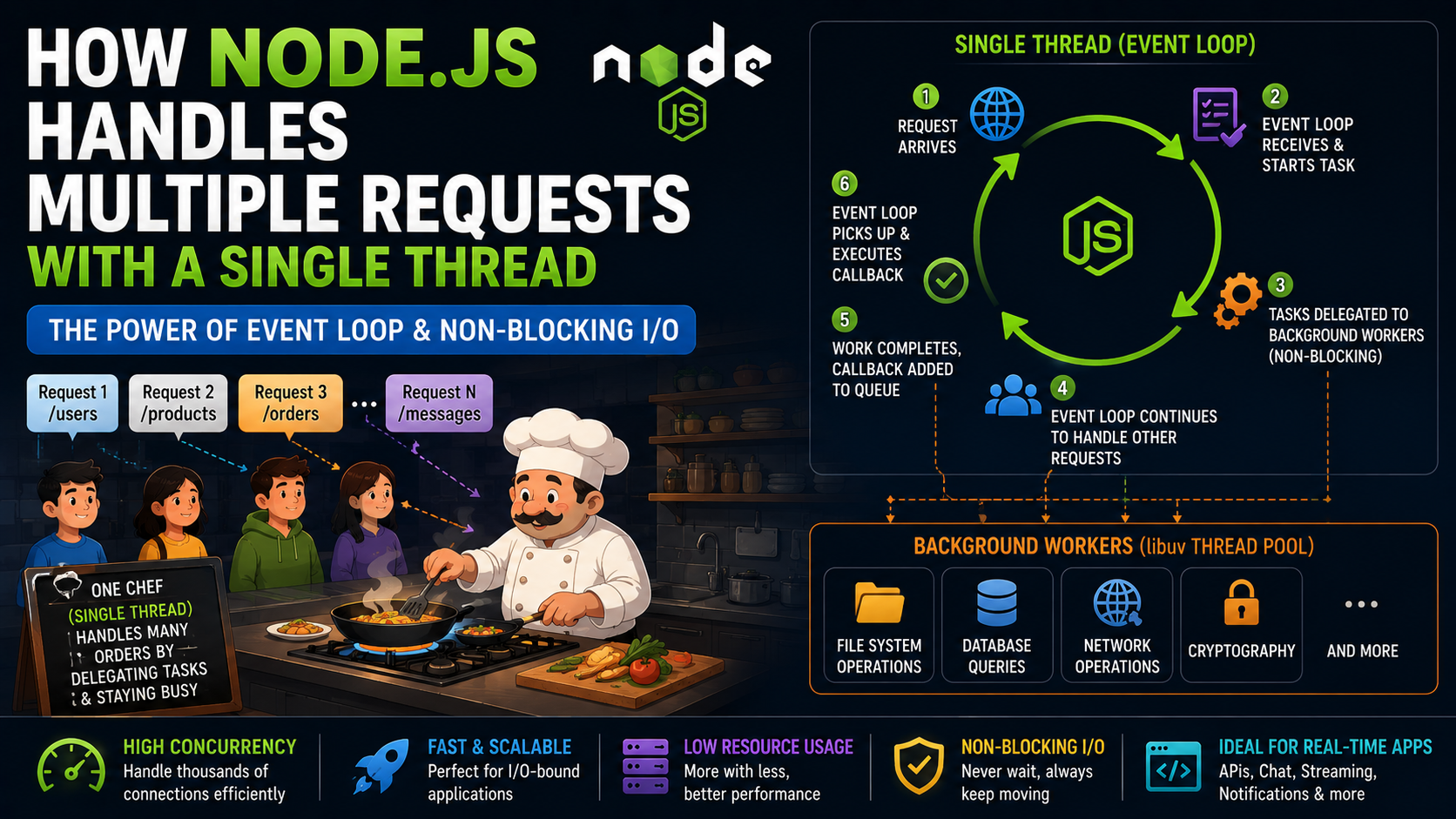
Single Thread Handling Multiple Requests


Role of the Event Loop
The secret hero behind Node.js scalability is:
The Event Loop
The event loop continuously checks:
completed tasks
pending callbacks
request queue
and executes tasks when ready.
Think of the event loop like restaurant manager coordinating workflow constantly.
Event Loop Basic Flow
Request arrives
      ↓
Task starts
      ↓
Background work happens
      ↓
Event loop checks completion
      ↓
Callback executes
That cycle repeats endlessly.
Example: File Reading
Imagine reading large file.
Without async handling:
Server freezes while waiting
Very bad.
With Node.js:
fs.readFile("data.txt", "utf8", (err, data) => {

  console.log(data);

});
Here:
file reading delegated
Node.js continues handling requests
callback runs later when complete
That’s non-blocking behavior.
Delegating Tasks to Background Workers
Important clarification:
Node.js itself uses single main thread for JavaScript execution.
BUT…
Certain heavy operations get delegated to:
Background worker threads
Examples include:
file system operations
database tasks
networking
cryptography
This delegation happens internally through:
libuv
(Node.js internal library)
No need to dive deeply into internals yet.
Just understand:
Slow tasks happen outside main thread
That’s the key idea.
Event Loop + Worker Thread Interaction Flow


Step-by-Step Request Handling
Imagine three users visit website simultaneously.
Step 1: Request Arrives
Node.js receives requests.
Step 2: Async Tasks Delegated
Database query starts in background.
Step 3: Main Thread Continues
Node.js immediately accepts more requests.
No waiting.
Step 4: Task Completes
Background worker finishes operation.
Step 5: Event Loop Executes Callback
Response sent back to user.
Efficient.
Smooth.
Scalable.
Why Blocking Code Is Dangerous
Blocking operations stop the single thread completely.
Example:
while(true) {

}
This blocks everything.
No requests handled.
Server becomes unresponsive.
Like chef freezing mid-kitchen and staring into void while customers riot outside.
Not ideal.
Why Node.js Scales Well
Node.js scales efficiently because it avoids wasting time waiting.
Instead of blocking:
tasks run asynchronously
event loop keeps moving
multiple users handled efficiently
This works especially well for:
APIs
chat applications
streaming services
real-time apps
Real-World Example: Chat App
Imagine thousands of users sending messages.
Each request involves:
network waiting
database operations
event handling
Node.js handles this extremely well because requests are mostly:
I/O bound
Meaning they spend lots of time waiting.
Node.js thrives in waiting-heavy systems.
Why Node.js Became Popular
Developers loved Node.js because it:
handled concurrency efficiently
used fewer resources
simplified real-time applications
performed well under many simultaneous connections
Especially compared to traditional blocking architectures.
Important Beginner Clarification
Many beginners think:
“Single-threaded means only one request at a time.”
Not true.
Node.js can handle many concurrent requests.
The magic comes from:
async delegation
event loop coordination
non-blocking execution
That distinction matters a lot.
Visualising Node.js Mentally
Think of Node.js as:
One super-organised manager
instead of:
Many workers doing everything manually
That mental model helps tremendously.
Common Beginner Mistake
Many beginners accidentally write blocking code inside Node.js servers.
Example:
heavy loops
CPU-intensive tasks
synchronous file reading
This blocks the event loop and hurts performance badly.
Always think:
"Will this block the main thread?"
Excellent habit.
Real-Life Analogy Recap
Traditional Blocking Server
One chef handles one order completely before next.
Node.js
One smart chef delegates cooking and keeps taking orders continuously.
Same kitchen.
Much better workflow.
Unique Tip for Beginners
Whenever learning Node.js, remember:
Node.js is fast because it avoids waiting
That single sentence explains most of its architecture philosophy.
Final Thoughts
Node.js handles multiple requests efficiently despite using a single main thread because it relies on:
asynchronous execution
event loop coordination
background worker delegation
non-blocking architecture
Instead of waiting for slow operations, Node.js continues processing incoming requests while background tasks complete independently.
At a high level:
single thread handles coordination
background systems handle slow work
event loop manages callbacks
And once you understand that workflow, Node.js scalability suddenly feels much less magical and much more logical.