Sessions vs JWT vs Cookies: Understanding Authentication Thoroughly
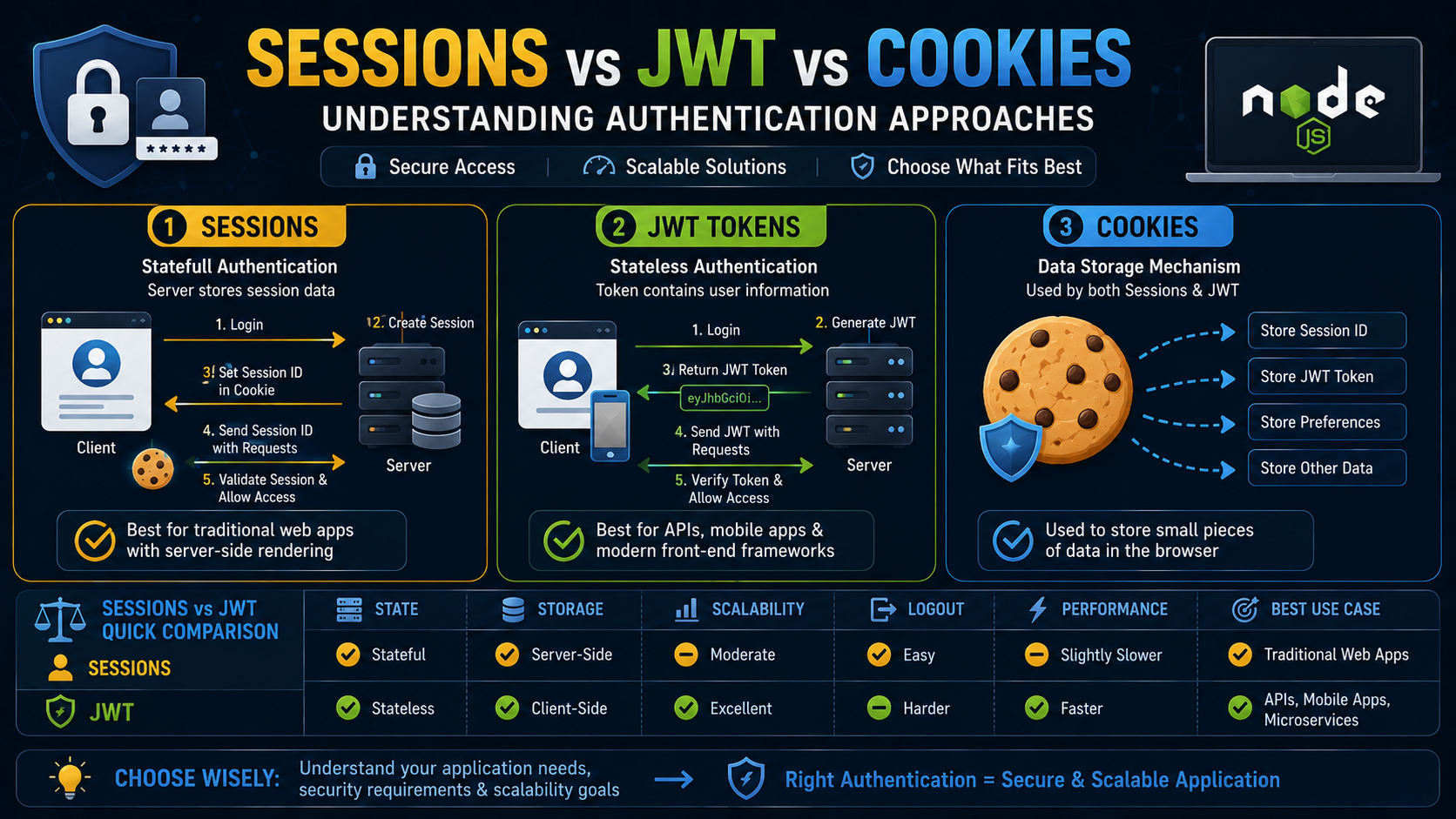
Introduction
Imagine entering a giant amusement park.
At the entrance, the staff needs a way to remember:
who paid for entry
who has VIP access
who is allowed on rides
who definitely should not eat a seventh ice cream
Now imagine three different systems.
System 1: Wristband System
The park gives you a wristband and stores your information in their database.
That’s basically:
Session-Based Authentication
System 2: Entry Ticket
The park gives you a signed ticket containing your information.
Staff simply checks the ticket each time.
That’s basically:
JWT Authentication
System 3: Tiny Sticky Note
The park gives your browser a small piece of stored information.
That’s basically:
Cookies
Modern authentication systems mainly revolve around these approaches.
And beginners often confuse them because they seem similar.
But they solve different problems.
In this guide, you’ll learn:
what sessions are
what cookies are
what JWT tokens are
stateful vs stateless authentication
differences between sessions and JWT
when to use each method
Let’s enter the amusement park.
Why Authentication Exists
Authentication answers one important question:
"Who are you?"
Applications need authentication because users access:
accounts
private data
dashboards
payments
protected resources
Without authentication:
Complete internet chaos
Which honestly sounds exhausting.
What Are Cookies?
Cookies are:
Small pieces of data stored in the browser
Websites use cookies to remember information.
Examples:
login state
theme preferences
shopping cart data
Think of cookies like tiny sticky notes stored by browser.
Cookie Example
When server sends:
Set-Cookie: user=Rahul
Browser stores it automatically.
Future requests include that cookie.
Important Clarification
Cookies themselves are:
Not authentication systems
They are simply storage mechanisms.
Cookies can store:
session IDs
JWT tokens
preferences
tracking data
Very important distinction.
Real-Life Analogy
Cookie
Tiny note in your pocket.
Session
Server-managed identity record.
JWT
Self-contained signed access pass.
Simple mental model.
What Are Sessions?
Sessions are:
Server-side authentication records
When user logs in:
server creates session
stores session data
sends session ID to browser
Browser usually stores session ID inside cookie.
Session Authentication Flow


How Session Authentication Works
Step 1: User Logs In
User sends:
username + password
Step 2: Server Creates Session
Example:
Session ID = abc123
Server stores session internally.
Step 3: Browser Stores Session ID
Usually inside cookie.
Step 4: Browser Sends Session ID with Requests
Server checks session storage.
Step 5: Access Granted
If session valid:
User authenticated
Stateful Authentication Explained
Sessions are called:
Stateful authentication
because server stores login state.
Server must remember:
active users
session IDs
session data
Think of it like hotel reception maintaining guest records manually.
Advantages of Sessions
easy to invalidate
server fully controls authentication
widely used traditionally
secure for many web apps
Disadvantages of Sessions
As applications scale:
server memory usage increases
session storage management becomes harder
distributed systems become more complex
That’s why JWT became popular.
What Is JWT?
JWT stands for:
JSON Web Token
JWT is:
A signed token containing user information
Unlike sessions:
Server doesn't store login state heavily
The token itself carries authentication data.
JWT Authentication Flow


How JWT Authentication Works
Step 1: User Logs In
Credentials sent to server.
Step 2: Server Generates JWT
Example:
eyJhbGciOi...
Step 3: Client Stores Token
Usually in:
localStorage
cookies
memory
Step 4: Client Sends Token with Requests
Typically inside:
Authorization: Bearer TOKEN
Step 5: Server Verifies Token
If valid:
Access granted
Stateless Authentication Explained
JWT uses:
Stateless authentication
because server does NOT need to store login sessions heavily.
The token itself contains identity information.
Think of JWT like a concert pass.
Security checks ticket validity instead of maintaining giant visitor notebook.
Advantages of JWT
scalable
lightweight
API-friendly
works well across services
ideal for mobile apps
Disadvantages of JWT
harder to invalidate immediately
larger payload size
token expiration handling needed
No system is perfect.
Authentication is basically choosing trade-offs intelligently.
Session vs JWT Comparison Table
FeatureSessionsJWTAuthentication TypeStatefulStatelessStorageServer-sideClient-sideScalabilityModerateExcellentServer Memory UsageHigherLowerEasy Logout HandlingYesHarderMobile/API FriendlyLess IdealExcellentToken SizeSmallLargerBest ForTraditional web appsAPIs & modern apps
Cookies vs Sessions vs JWT
This confusion is extremely common.
Let’s simplify clearly.
Cookies
Storage mechanism.
Sessions
Authentication system using server storage.
Usually uses cookies.
JWT
Self-contained token authentication system.
Can ALSO use cookies.
Important Clarification
Cookies and JWT are NOT competitors directly.
JWT tokens themselves are often stored:
Inside cookies
Very common setup.
Authentication System Visualisation
Cookie = storage box

Session = server remembers user

JWT = token remembers user info
That mental model helps tremendously.
When to Use Sessions
Sessions work well for:
traditional server-rendered websites
small-to-medium applications
applications needing strong session control
Examples:
banking systems
admin dashboards
classic web apps
When to Use JWT
JWT works best for:
REST APIs
mobile applications
frontend-backend separation
microservices
Examples:
React apps
mobile apps
distributed systems
Why JWT Became So Popular
Modern applications often involve:
frontend frameworks
separate backend APIs
mobile apps
multiple services
JWT fits these architectures extremely well because it’s stateless and portable.
Common Beginner Mistake
Many beginners think:
JWT = more secure automatically
Not necessarily.
Security depends heavily on:
implementation
storage strategy
HTTPS
expiration handling
No authentication method magically solves everything.
Another Common Mistake
Confusing:
Cookies
with:
Sessions
Remember:
Sessions often USE cookies
but they are not the same thing.
Very important distinction.
Real-Life Analogy Recap
Cookies
Tiny browser sticky notes.
Sessions
Hotel receptionist remembering guests manually.
JWT
Digitally signed concert pass.
Each solves authentication differently.
Why Authentication Decisions Matter
Choosing wrong authentication strategy affects:
scalability
performance
architecture complexity
mobile support
user experience
There is no universal “best” solution.
Only:
Best solution for specific use case
That’s how real engineering decisions work.
Unique Tip for Beginners
When learning authentication, focus first on:
Understanding the flow
instead of memorising libraries immediately.
If you understand:
Login → Identity → Verification → Access
every authentication system becomes easier later.
Final Thoughts
Sessions, JWTs, and cookies are all important pieces of modern authentication systems.
At a high level:
cookies store small browser data
sessions store authentication state on server
JWT stores identity inside signed token
Sessions provide:
strong server control
simpler invalidation
JWT provides:
scalability
stateless architecture
API flexibility
Understanding when to use each approach is one of the most valuable backend development skills beginners can learn.
And once you stop viewing authentication as “magic login stuff” and start seeing it as identity management, everything becomes much more understandable.